


The NUN’S GUIDE
“Con tutti voi!”
@nunsguide || Bishop’s Stortford
“We are one family, with one Father,
who makes the sun rise on everyone;
we inhabit the same planet and we
must care for it together”
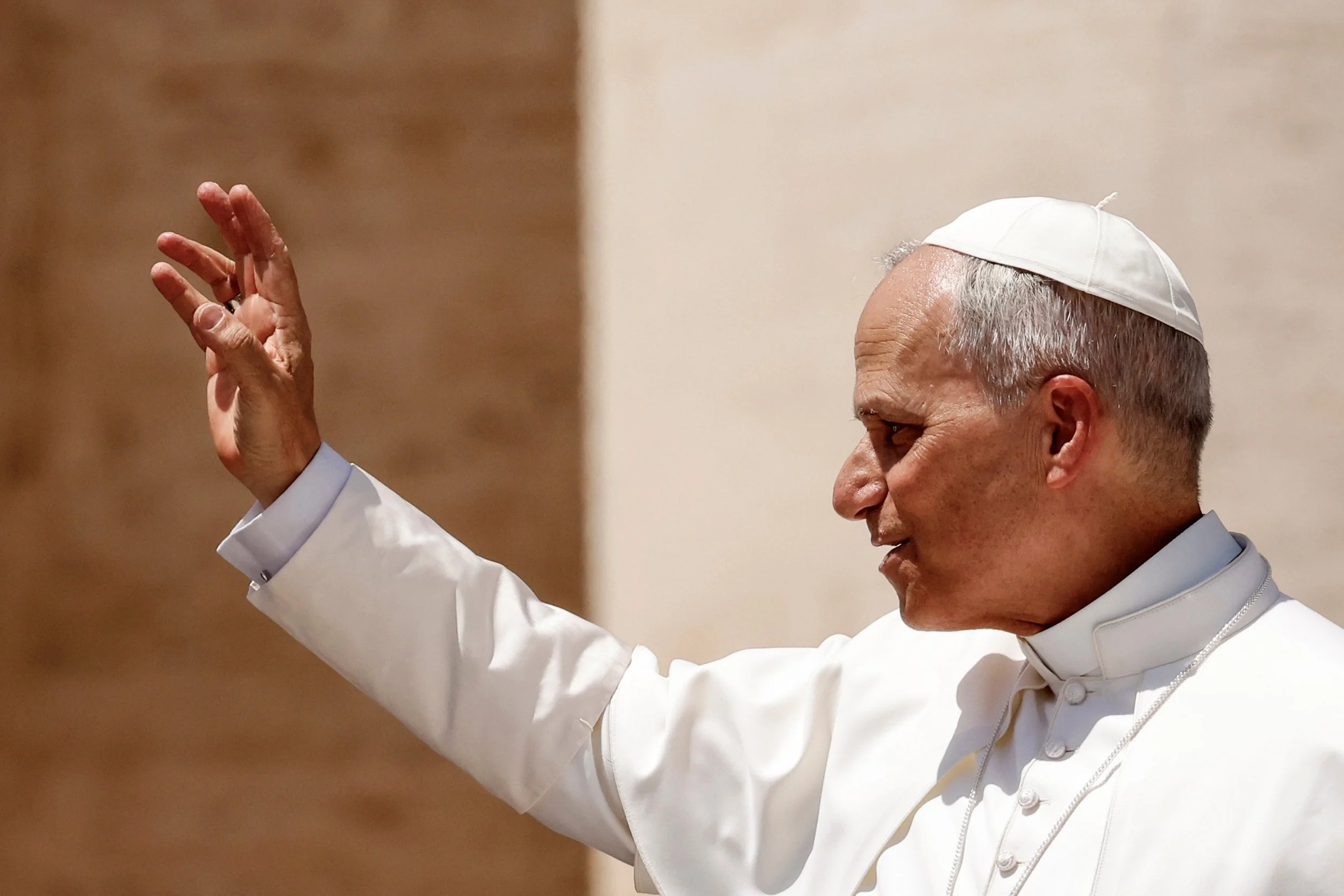
Shutterstock © Riccardo De Luca
The Peace of Christ
“Peace be with you all! Brothers and sisters, these are the first words spoken by the risen Christ, the Good Shepherd, who laid down his life for God’s flock. I would like this greeting of peace to resound in your hearts, in your families, among all people, in every nation throughout the world: peace be with you!
It is the peace of the risen Christ. A peace that is unarmed and disarming, humble and persevering, a peace that comes from God, the God who loves us all, unconditionally. To all of you, brothers and sisters in Rome, in Italy, throughout the world, we want to be a Church that moves forward, that always seeks peace, that always seeks to be close above all to those who are suffering.”
Pope Leo XIV’s first address to the faithful
Saint Peter’s Square
Thursday 8th May 2025
DIARIO del PAPA
CHRISTMAS EVE
Holy Mass (10pm, Rome time), Saint Peter’s Basilica, for the Nativity of the Lord
CHRISTMAS DAY
Holy Mass (10am, Rome time), Saint Peter’s Basilica, for the Nativity of the Lord
edizione 2026

FREE for PRIESTS || Biodegradable ink
the
Nun’s
Guide
to the immense spiritual
treasures of the Church
Landmarks
& pilgrimages
Thriving monasteries
Seminarians on the
calling to the cloth
Finding today’s Bernini
Heavenly cathedrals
Understanding all 38
‘Doctors of the Church’
Sisters of Charity of Saint
Vincent de Paul by Armand
Gautier 1850


❸ Santa Maria della Vittoria
Monti district, 1st Rione
Marble basilica with Bernini’s scandalous sculpture of Saint Teresa of Ávila in ecstasy, her head thrown back, the rippling folds of her habit, a symbol of chastity and containment, churned into an ocean of surging and cresting waves, according to art critic Simon Schama, seeing her “helpless dissolution into liquid bliss”
Power of Art, BBC
❹ San Silvestro in Capite
Colonna, 3rd Rione
Built as a shrine for relics from the catacombs, the Basilica of Saint Sylvester, a church-building Pope who fled the city, was given to the British in Rome, with Mass in English overlooked by statues by Michelangelo and the very head of John the Baptist
❺ Basilica di Sant’Agostino
Campo Marzio, 4th Rione
Behind the longevity of Saint Augustine is his pious mother, Santa Monica. “Go,” one bishop told her, wearied by her worrying about her son’s wayward ways; no son could be lost after “so many tears” and her remains are now interned in a brightly-painted basilica in the heart of Rome, surrounded by paintings by Raphael and Caravaggio
❻ Santissima Trinita
dei Pellegrini
Regola, 7th Rione
For Mass in Latin, most solemn and reverential, and setting aside as infelicitous the most recent 60 years of sweeping church reform, traditionalists squeeze into the Church of the Most Holy Trinity, used by Saint Philip Neri to bring thousands of pilgrims to Rome
An icon for the timeless and unwavering truth of the church, Neri also rebuilt Santa Maria in Vallicella in Rome’s 6th Rione, the home of his religious order, the Oratorians, who are still preaching a brave pushback against the blurred lines of modernism
930 +
…churches in Rome
served by 10,362 priests
❼ Sant’Anastasia al Palatino
Campitelli, 10th Rione
Architectural masterpiece where the great translator, Saint Jerome, used to celebrate Mass, now home to the devout Keralan community; relics include Saint Joseph’s staff and the Virgin Mary’s veil
❽ Santa Cecilia
Trastevere, 13th Rione
Refusing to marry a pagan nobleman, Saint Cecilia was brutally martyred by Roman soldiers and is now the patron saint of musicians, who treat her basilica like a public concert hall, surrounded by some of history’s most venerated relics
❾ Chiesa di Dio Padre Misericordioso
In Rome’s long summer evenings, from Easter until October, a group meet at midnight every Saturday at Piazza di Porta Capena in Rome’s 10th Rione, walking 14 km through the night and arriving for Mass at dawn at the Sanctuary of the Madonna of Divine Love, a place of miracles and prayer, though there is a shorter journey to the Church of God the Merciful Father, glowing with titanium-based cement in Municipio V, designed by American artist Richard Meier
Sketchify © Architas & Bgabel


DIVINE COMMUNION
“Your gold and silver have rusted,” warns the Letter of James, “and their rust will be evidence against you and it will eat your flesh like fire. You have laid up treasure for the last days. Listen! The wages of the labourers who mowed your fields, which you kept back by fraud, cry out, and the cries of the harvesters have reached the ears of the Lord.”
Such is the Bible’s call to those living in luxury and pleasure. For Saint Ambrose (c.339 to 397), Bishop of Milan, giving alms was not a paternal gesture, but justice restored. “Do not honour Christ’s body here in church with silk fabrics,” preached Saint John Chrysostom (347 to 407), Archbishop of Constantinople, “while he himself dies of hunger in the person of the poor.”
Saint Clare of Assisi (1194 to 1253) also chose barefooted poverty over papal privileges, teaching her sisters to trust purely in God and see Christ as their only inheritance, letting nothing obscure their communion with him. From the day of his birth in a humble manger, taken to the Temple by Joseph and Mary with two turtledoves, the sacrifice of the lowly, God lived on earth as an itinerant teacher, his poverty and precariousness both signs of his spiritual bond to his Father and trust in providence to the end.
“I express my heartfelt gratitude to all those who have chosen to live among the poor,” writes Pope Leo XIV in his Apostolic Exhortation, Dilexi Te, “not merely to pay them an occasional visit but to live with them as they do… one of the highest forms of evangelical life.”


Published by Pope Francis three months after his election in 2013, Lumen Fidei, “The Light of Faith”, followed two letters published by Pope Benedict XVI on Hope and Charity
“If we look down to Earth from the heights of heaven,” wrote the Greek pagan Celsus, who dismissed early Christians as deluded, “would there really be any difference between our activities and those of the ants and bees?”
Pope Leo’s first letter to the faithful, Dilexi Te, on the spiritual meaning of poverty, was originally drafted by his predecessor, Pope Francis, whose first encyclical letter likewise completed a paper begun by Pope Benedict XVI: Lumen Fidei, the light of faith, is a monumental meditation on radiance and love, and the futility of non-belief, reaching to “the core of all being, the inmost secret of all reality.”
As two great poles of the Church, the lofty scholarship of Benedict and the all-encompassing forgiveness of Francis lift high the vast tent of human experience, from its wandering in Biblical deserts through the questioning lament of French philosopher Jean-Jacques Rousseau (1712 to 1778) and the doubts of Russian novelist Fyodor Dostoyevsky (1821 to 1881) to the present crisis of godless individualism.
God is first removed from our everyday lives and put on a different level, consigned to the far beyond. Without his presence, human life is no longer precious or unique and man is cast adrift in nature, renouncing his responsibilities, or assuming the role of a judge, with unlimited power to manipulate his surroundings. “Once man has lost the fundamental orientation which unifies his existence, he breaks down into the multiplicity of his desires; in refusing to await the time of promise, his life-story disintegrates into a myriad of unconnected instants.”
Even then, any heart can be easily moved by the beauty and grandeur of life, glimpsing the entire movement of the cosmos towards its fulfilment. Stepping aside from our selfish and enclosed egos, we quickly find and recognise Christ, enlarging our lives into a plan infinitely bigger than our own undertakings.
But faith is even more than a dialogue between the divine Father and a believing, obedient Son. As we draw nearer our Creator, our humanity is not dissolved in the immensity of his light, as a star is engulfed by the dawn, but shines more brightly, like a mirror.
Seeing things as Jesus sees them, with his own eyes, we come to share in Christ’s mind. Perceiving its deepest meaning, we see how God loves the world, constantly guiding it towards himself, encouraging us to live with ever-greater commitment and intensity as we are taken-up in the great pilgrimage of the Church through time, purifying all things, and bringing them to their finest expression, assimilating everything it meets.

Taking a break from the tax-free shopping, the busiest pharmacy in Italy and the huge crowds of nuns in Saint Peter’s Square, where Pope Leo XIV appears to the faithful every Wednesday at 9am and Sunday at midday, American seminarians say the hidden German Cemetary is the most peaceful place to stop and pray anywhere in Vatican City
Shutterstock © Anastasia Prisunko

PRAYER OF DON TONINO BELLO
“Holy Mary, nourish in our Churches the desire for communion. Help them overcome internal divisions, intervene when the demon of discord creeps into their midst, extinguish the fires of factionalism, reconcile mutual disputes, defuse their rivalries, stop them when they decide to go their own way.”
A Humble Church
“We must dream of a humble Church that does not stand upright like the Pharisee, triumphant and inflated with pride, but bends down to wash the feet of humanity. In the Christian community, primacy belongs to the spiritual life, where relation-ships do not respond to the logic of hierarchies, structures and power. We are all children of God, called to serve one another. The supreme rule in the Church is love. No one is called to dominate; all are called to serve. We must listen to one another. No one is excluded and no one possesses the whole truth; we must humbly seek it together. We are invited to rediscover the mystery of the Church, where God intends to bring us all together into one family of brothers and sisters and make us his people, united in the embrace of his love.”
Holy Mass in St Peter’s
Sunday 26th October 2025
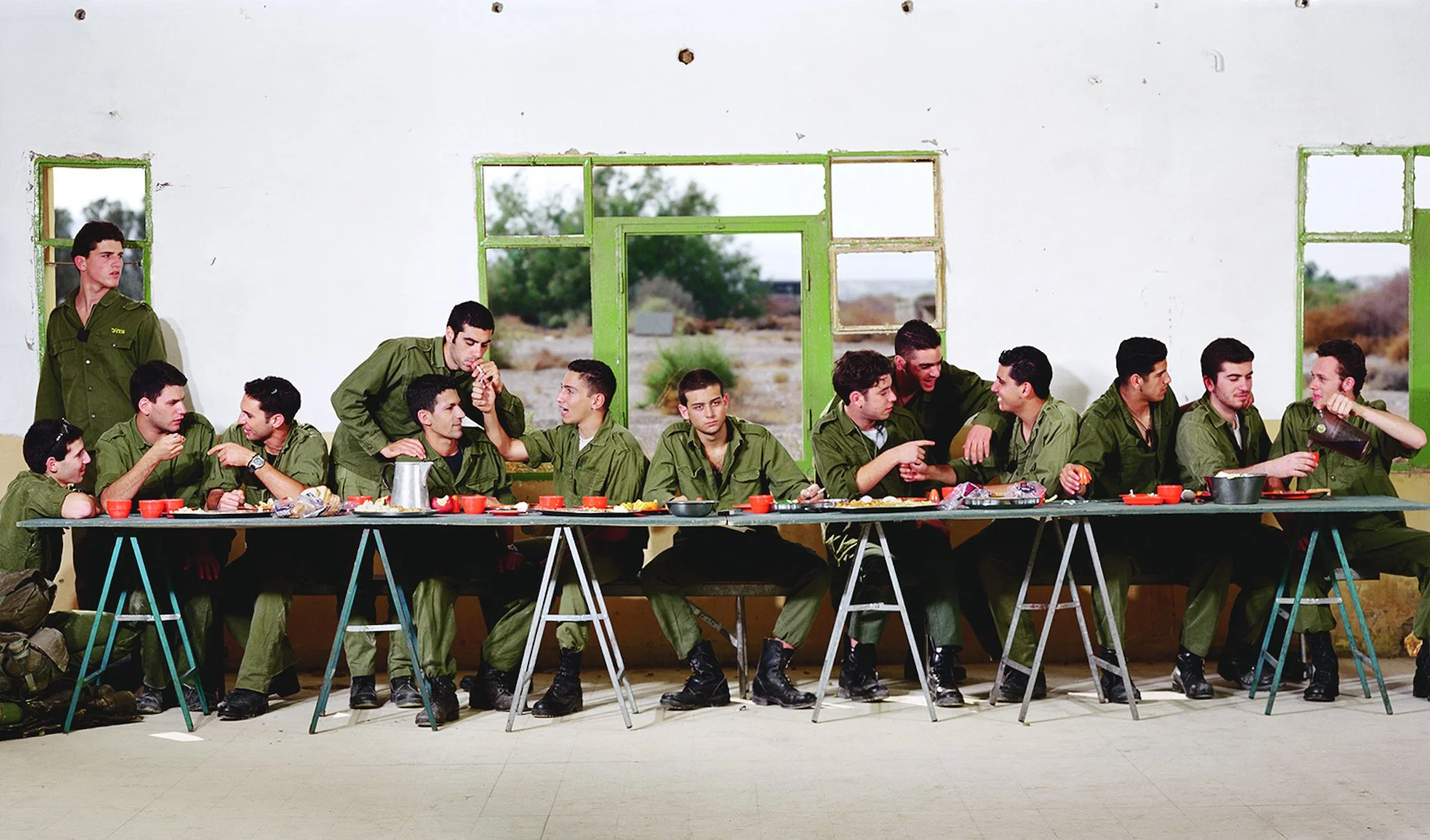
Last Supper (1999) by Adi Nes in the Israel Museum, Jerusalem
La Preparazione di Cristo
Go into the city and you will meet a man carrying a pitcher of water. Follow him, and say to the owner of the house which he enters, “The Master says, where is my dining room in which I can eat the Passover with my disciples?” He will show you a large upper room furnished with couches, all prepared
Mark (chapter 14, verse 13)
Pope Leo XIV on the Readiness of Christ
Let us reflect on a word that holds a precious secret of Christian life. His disciples say to Jesus, “Where will you have us go and prepare for you to eat the Passover?” His answer is almost a riddle: “Go into the city and a man carrying a pitcher of water will meet you,” as if everything has been arranged in advance.
The Gospel tells us that love is not the product of chance. Jesus does not face his Passion out of fatalism, but fidelity to a path carefully followed. The gift of his life stems from profound intention, not a sudden impulse. The upper room, furnished and ready, tells us that God always precedes us and prepares a place for us. This space is fundamentally our heart, a room that may seem empty, but waits to be recognised, filled and cherished.
Today too, there is a supper to prepare: the Eucharist is not only celebrated at the altar, but in daily life, where it is possible to experience everything as an offering of thanks. This does not mean doing more, but leaving room, removing what encumbers us, reducing our demands, ceasing to hold unrealistic expectations. Illusions distract us and seek a result; preparations guide us and make encounter possible. True love, the Gospel reminds us, is given in advance, not based on what it receives, but on what it wishes to offer.
Every gesture of availability, every gratuitous act, every act of forgiveness made in advance, every struggle patiently accepted, is a way to prepare a place where God can dwell. What spaces in my life do I need to put in order so they are ready to receive the Lord? What does it mean for me today to prepare?
If we accept the invitation we will discover that we are surrounded by signs, encounters and words that guide us towards that room, spacious and prepared, in which the mystery of an infinite love is celebrated unceasingly. May the Lord grant us to be humble preparers of his presence, and, in this daily readiness, may serene trust grow in us, allowing us to face everything with a free heart. Because where love has been prepared, life can truly flourish.
Saint Peter’s Square
Wednesday 6th August


Shutterstock © Marco Iacobucci Epp
The Resurrection
The centre of our faith and hope are firmly rooted in the Resurrection of Christ, which is not a bombastic triumph, nor revenge or retaliation against his enemies, but a wonderful testimony to how love rises again after a great defeat to continue its unstoppable journey.
When we get up again after a trauma, often the first reaction is anger, to make someone pay for what we have suffered. The Risen One does not react this way. When he emerges from the underworld, Jesus does not return with gestures of power, but with meekness he manifests a love greater than any wound and stronger than any betrayal.
The Risen One does not feel any need to reiterate his superiority. He appears to his friends, the disciples, and he does so with extreme discretion. His desire is to be in communion with them, helping them overcome their sense of guilt in the Upper Room, where they are enclosed in fear.
It is a moment that expresses extraordinary strength. After descending into the abyss of death to liberate those imprisoned there, Jesus enters the closed room, bringing a gift that no one dared hope for.
His greeting is simple, almost ordinary: “Peace be with you.” But it is accompanied by a gesture so beautiful that it is almost disconcerting. Jesus shows the disciples his hands and his side, with the marks of the Passion. Why show his wounds to those who had denied and abandoned him? Why not hide those signs of pain?
Seeing the Lord, the disciples rejoice. Jesus is fully reconciled with everything he has suffered. There is no shadow of resentment. The wounds serve not to reproach, but confirm a love stronger than any infidelity. They are proof that in the moment of our failure, God did not retreat. He did not give up on us.
The Lord presents himself naked and defenceless. He does not makes demands, nor hold us to ransom. His is a love that does not humiliate. It is the peace of one who has suffered for love and affirms that it was worthwhile.
We often mask our wounds out of pride, or fear of appearing weak. We say, ‘It doesn’t matter, it is all in the past’, but we are not at peace with the betrayals that have wounded us. We prefer to hide our struggle so as not to appear vulnerable, or risk suffering again, but Jesus offers his wounds as a guarantee of forgiveness: the Resurrection is not the erasure of the past, but its transfiguration into mercy.
The Lord then repeats: ‘Peace be with you,’ and adds, “As the Father has sent me, so I send you.” With these words, he entrusts the apostles with a responsibility to be instruments of reconciliation, as if to say, ‘Who will be able to proclaim the merciful face of the Father, if not you, who have experienced failure and forgiveness?’
Jesus breathes on them and gives them the same Holy Spirit that sustained him in obedience to the Father onto the cross. The apostles will no longer remain silent about what they have seen: that God forgives, lifts up, and restores trust.
This is the heart of the Church’s mission: not to administer power over others, but to communicate the joy of those who were loved when they did not deserve it. It is the strength that gave rise to the Christian community and made it grow.
Dear brothers and sisters, we too are sent. The Lord also shows us his wounds and says, ‘Peace be with you.’ Do not be afraid to show your wounds healed by mercy. Do not be afraid to draw close to those who are trapped in fear or guilt. May the breath of the Holy Spirit make us, too, witnesses of this peace and love that is stronger than any defeat.